
Manage digital templates
Digital templates allow you to customize email and text messages and apply branding to emails, so you can easily reuse consistent messaging when sending rewards. Digital templates support both text messages and emails.
To activate the text messages or mobile reward delivery feature for your platform, you must accept the Mobile Delivery Addendum through the Tango portal on behalf of your organization. The Addendum establishes additional terms governing the use of mobile reward delivery. This feature is disabled by default and can be enabled in the Platform settings. See how you can Enable mobile reward delivery.
Mobile reward delivery settings apply organization-wide to all accounts. Custom digital templates can be assigned and accessed at the platform, customer (group), or account levels. Not all rewards qualify for mobile reward delivery. If the reward is not eligible for mobile reward delivery, the PHONE attribute will not be included in the UTID.
Note:
- Email templates are now replaced with digital templates in Tango API. Digital templates support both email and Text delivery.
- Text delivery requires Mobile reward delivery to be enabled for your platform. Only rewards that support mobile delivery include the PHONE delivery attribute in their UTID configuration.
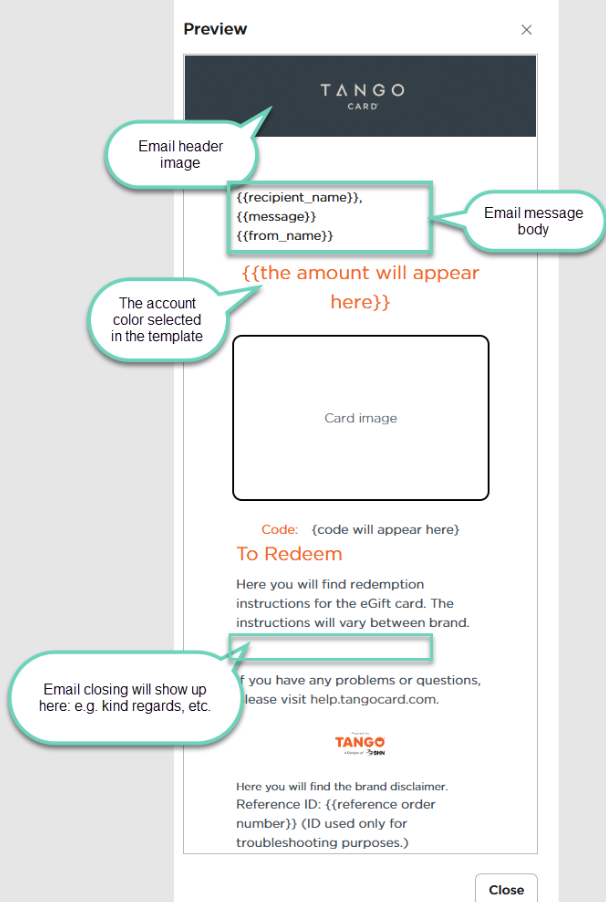
Here is an example of the digital template for email:
Assign digital template to an account
You can assign a digital template to a specific account or customer (group) so that the particular digital template will not be accessible by any other account or customer (group). This helps maintain brand consistency and prevents unintended use across unrelated accounts. If you want a digital template to be universally accessible to all accounts under your platform, set its access level to platform-wide.
Default vs. standard vs. custom digital template
Tango supports three template types:
- Standard template (ETID E000000): The pre-built template provided by Tango.
- Custom template: A template that you create and manage for your organization.
- Default template: The template automatically used when an order is submitted without a specific ETID. A default template can be either the Tango standard template or one of your custom templates. You can set a default template for your entire platform, a specific group, or an account, or restrict it to a particular level. The default digital template will automatically be applied to all rewards in your order. There is no limit on the number of custom digital templates you can create.
Best practice:Use a custom digital template instead of the standard ETID E000000. While the standard template successfully delivers rewards, it uses the generic "Tango Card" as the sender name as opposed to a specific sender.
When an order is placed through the Tango Portal, a digital template must be selected. When an order is placed through the Tango API, a template is optional. If no ETID is provided in an API request, Tango looks for a default template in the following order: account, customer (group), and platform. If no default template is found, the rewards will be sent with the "Tango Card Standard Template" or (ETID E000000).
Dynamic tags in digital template
We support a variety of dynamic (mustache) tags that can be inserted into email or text elements of a digital template. To use dynamic tags, create a digital template first by using POST {URI}/digitalTemplates . Then include Tango-supported body parameters, such as name, fromName, subject, etc. These tags are automatically replaced with actual values when the reward is sent via the Tango API or portal. See how to Create a new digital template.
Here are the dynamic tags for the digital template:
| Digital template dynamic tags | EMAIL/TEXT | Description |
|---|---|---|
{{recipient_name}} | email message body, text message content | It is a placeholder for the recipient's first name and last name when a message is sent. It's replaced with the recipient's full name when the message is sent. |
{{message}} | email message body | This is a placeholder for the email message body. It's used as a complementary tool to personalize the sent with rewards. |
{{reward_name}} | email message body | It is a placeholder for the reward name in the email message body that is being sent to the recipient. It's used as a complementary tool to personalize the sent with rewards. |
{{from_name}} | email message body, email closing, text message content | This is a placeholder for the sender’s name, such as your company or team name. It's replaced with the sender or company name configured in the template. |
{{reward_amount}} | text message content | This is a placeholder for the reward amount in the text message sent to the recipient. |
Example
Subject:
{{from_name}} sent you a reward

Email Body:
Hi {{recipient_name}},

{{message}}

Reward: {{reward_name}}

Thanks,
{{from_name}}
Customer service message via digital template
By default, Tango provides recipient support information in reward communications. If your organization provides first-tier recipient support, specify a custom customerServiceMessage when creating the template. Otherwise, Tango support information will be used. The customer service message usually appears in the footer or closing section of the email or text message.
See the example below:
  "messageBody": "Hi {{recipient_name}}, {{message}}",
  "smsMessageBody": "You've got a reward from {{from_name}}!",
  "closing": "Enjoy your reward!",
  "customerServiceMessage": "Need help? Contact us at [email protected] or call 1-800-123-4567.",
  "accessControl": [
    {
Updated about 1 month ago